
Are you struggling to get consistent organic visitors to your blog and looking for a reliable way to get free traffic from Google? In this article, you will learn how to find long tail keywords with Google Keyword Planner step by step, using the latest 2026 interface and settings.
This is a practical, basic keyword research method that I personally use in my blogging journey to find low‑competition long tail keywords and improve my rankings in Google. I will show you exactly how to use Google Keyword Planner to discover profitable long‑tail keyword ideas for your blog posts, even if you are a complete beginner.
The best part is that Google Keyword Planner is a completely free tool inside Google Ads, so you can do unlimited long‑tail keyword research without paying for expensive SEO tools.
This Google Keyword Planner tutorial for bloggers shows you a simple, step‑by‑step process to find long‑tail keywords that can boost your blog traffic.
What is Google Keyword Planner?
Google Keyword Planner is a free keyword research tool inside the Google Ads platform that helps you discover the search terms people type into Google and how often they search for them. It shows important metrics like average monthly searches, competition level, and estimated cost‑per‑click, which you can use to plan both SEO content and Google Ads campaigns.
Although Google designed Keyword Planner primarily for advertisers, bloggers, and SEO professionals can also use it to find long‑tail keyword ideas, validate search demand, and build content that better matches user intent.
Even though it is built for advertisers, you can easily use the Google Ads keyword planner for SEO to research topics, validate search demand, and plan your content strategy.
To access it, you simply create a Google Ads account, open the Tools & Settings menu, and choose Keyword Planner under the “Planning” section.
Key features of Google Keyword Planner
- Generates keyword ideas based on a seed keyword or website URL.
- Shows average monthly searches, competition, and bid ranges for each keyword.
- Allows filtering by location, language, and search network so you can focus on your target audience.
- Let’s you download keyword ideas as a CSV file for deeper analysis in Excel or Google Sheets.
- Helps you group and organize keywords into ad groups or content clusters for better planning.
Who is this guide for?
This guide is for bloggers, affiliate marketers, small business owners, and SEO professionals who want to use Google Keyword Planner to find long‑tail keywords, improve their content strategy, and grow consistent organic traffic without spending money on expensive tools.
What are Long tail keywords?
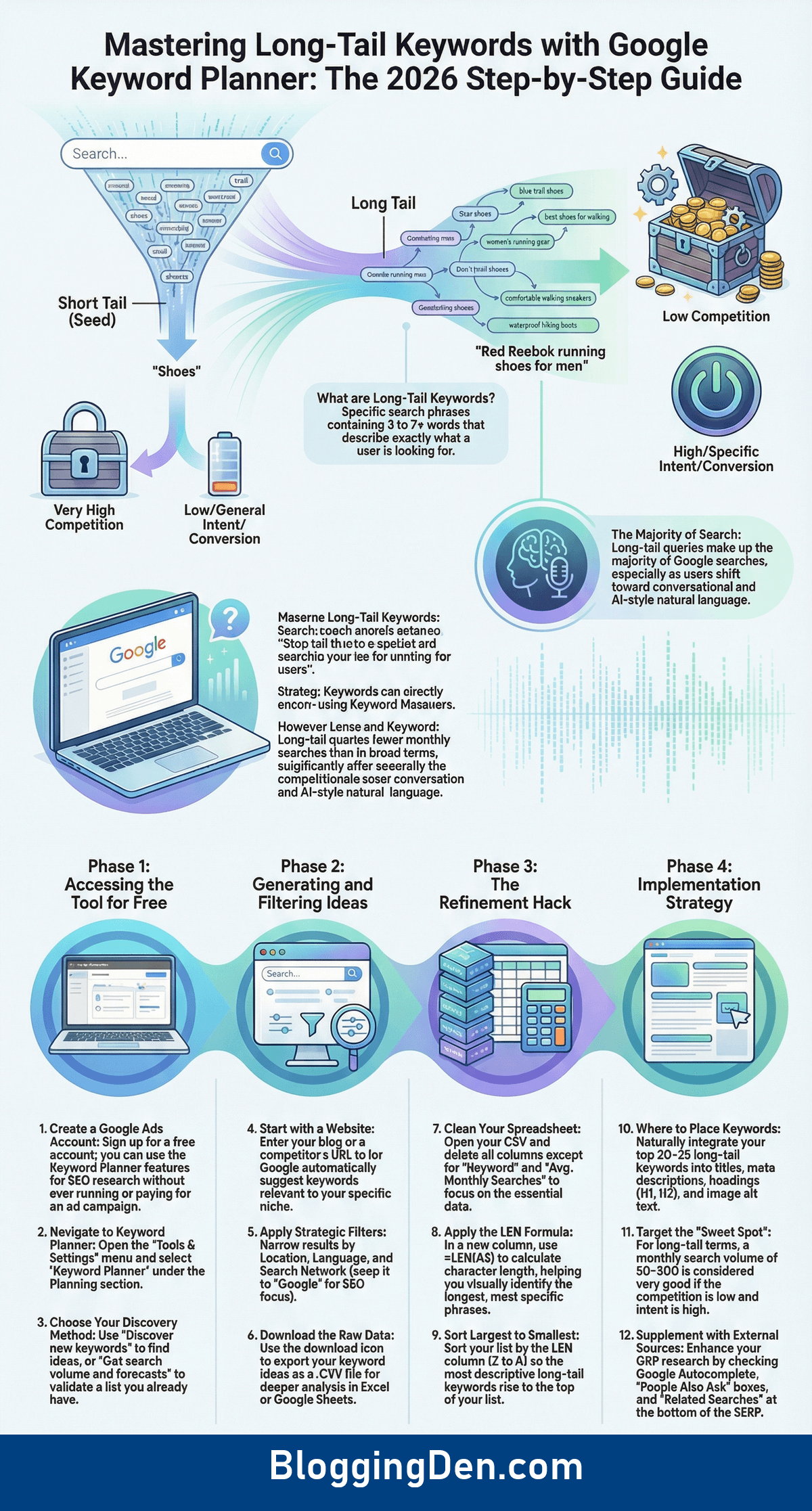
Long tail keywords are longer, more specific search phrases that usually contain three to seven or more words and describe exactly what a user is looking for.
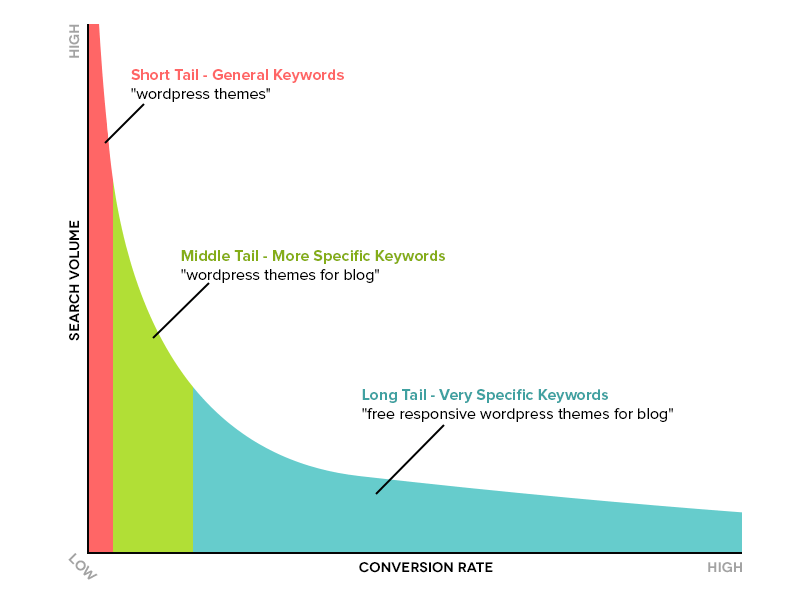
Examples would be “best WordPress SEO plugins for beginners” instead of just “SEO plugins” or “cheap web hosting for new bloggers” instead of simply “web hosting”.
Because they are so specific, long‑tail keywords usually have lower search volume but also much lower competition, making them easier to rank for in Google.
At the same time, they reflect higher intent and better conversion potential, so they often deliver more targeted visitors who are closer to taking action.
Together, long‑tail searches actually make up the majority of queries on Google, especially with people using natural, conversational phrases.
That’s why they tend to get higher click‑through rates, match searcher intent more accurately, and work extremely well for voice search and AI‑style natural language queries.
How to find long‑tail keywords with Google Keyword Planner?
If you are not using the right keywords, you will naturally lose a lot of organic traffic from search engines.
Choosing proper long‑tail keywords is critical if you want your blog posts to rank and bring in consistent visitors. This tutorial will show you exactly how to do that using Google Keyword Planner.
How to use the Google Keyword Planner tool for free?
To start finding long‑tail keywords, you need a free Google Ads account (formerly called Google AdWords).
After creating and logging in to your Google Ads account, you can access Keyword Planner from the Tools & Settings menu under the “Planning” section and begin your keyword research.
If you are a complete beginner and have never used Google Keyword Planner before, do not worry.
In the next steps, I will walk you through a simple, step‑by‑step picture guide to get long‑tail keywords using the Google Keyword Planner tool for free, without spending hundreds of dollars every month on premium SEO tools
This is the same practical method I personally use to pick profitable long‑tail keywords for my own blog posts.
Just follow the steps below on how to use the Google Keyword Planner tool, and you will be able to build a list of targeted long‑tail keywords for your next articles.
So let’s start the steps.
Prerequisites: Google Ads and Keyword Planner access
To use Google Keyword Planner, you need a free Google Ads account.
Sign in to Google Ads, then click the Tools & Settings icon in the top menu and select Keyword Planner under the “Planning” section.
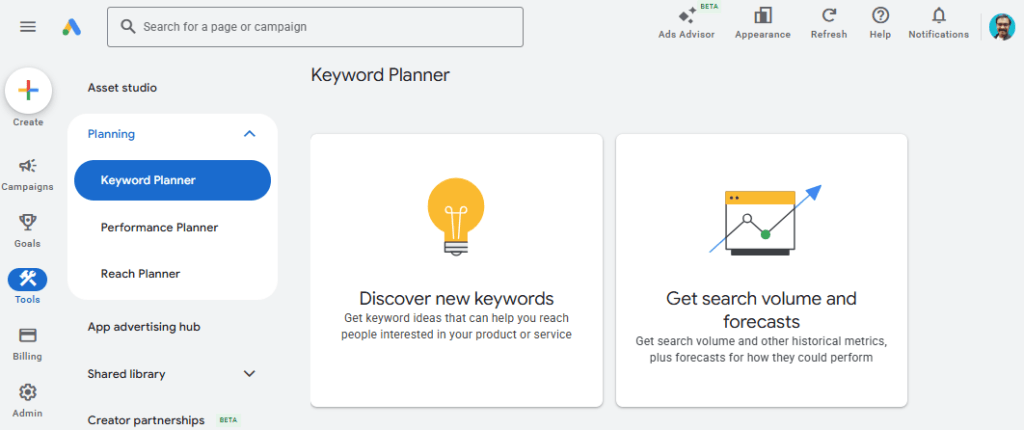
Inside Keyword Planner, you will mainly use two options: Discover new keywords and Get search volume and forecasts.
If you do not have an Adwords account, click on Create account link and follow the instructions to complete your registration for free.
Step 1: Open “Discover new keywords”
After successful login or new account verification, you need to choose Tools > KEYWORD PLANNER to continue.
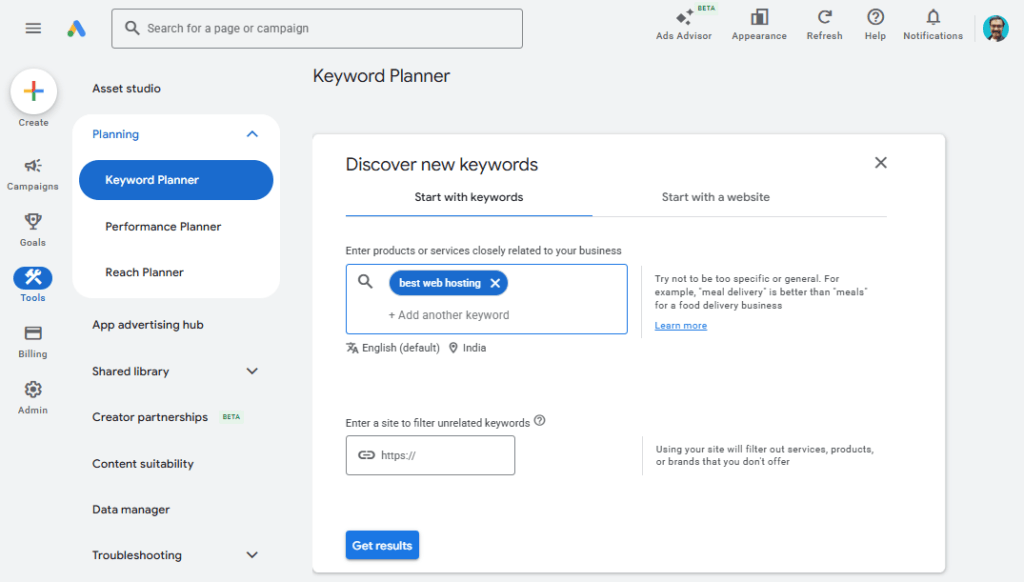
From the Keyword Planner dashboard, click Discover new keywords. You will see two starting options:
- Start with keywords – enter 1–10 seed phrases manually.
- Start with a website – let Google scan a URL to suggest relevant keyword ideas.
For bloggers and niche sites, “Start with a website” option is very powerful because Google analyzes your blog’s content and suggests related long‑tail keyword ideas automatically.
Step 2: Choose “Start with website” (recommended for bloggers)
Select the Start with a website tab. Enter your blog home page, a specific category URL, or even a single article URL if you want tightly‑related keyword ideas.
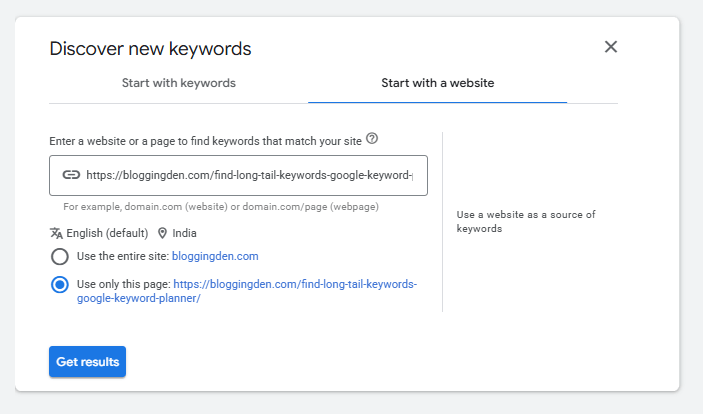
Choose whether Google should “Use only this page” or “Use the entire site” based on how broad you want the ideas to be.
Click Get results to load the keyword ideas.
(You can still test Start with keywords for your main seed term, like “blogging tips” or “WordPress SEO,” if you prefer a more controlled list of long‑tail variations.)
Step 3: Apply the right filters (location, language, date range, negatives)
At the top of the results page, set the key filters so the ideas match your audience:
- Location – choose the country or region you are targeting (for example, India, the United States, or multiple countries).
- Language – usually English, or the primary language of your audience.
- Search networks – keep it on Google only for SEO‑focused research.
- Date range – keep it to the last 12 months or adjust if you want seasonality insights.
Next, click on Add filter and use Keyword text or Exclude keywords in my account to remove noisy ideas.
You can also add negative keywords (for example, brand names, competitor names, or unrelated terms) so they do not appear in your list.
This cleanup stage helps you get a more relevant, easier‑to‑analyze set of potential long‑tail keywords.
Step 4: Use “Get search volume and forecasts” for validation (optional)
Once you have a shortlist of candidate keywords, go back to the Keyword Planner home screen and choose Get search volume and forecasts.
Paste your selected keywords into the box and click Get started to see estimated impressions, clicks, and CPC data.
This is useful to compare multiple long‑tail keywords side by side and prioritize the ones with better potential traffic and commercial value.
Bonus tip: If you ever decide to run a very low‑budget test campaign, Google may show more precise volume numbers instead of wide ranges, which can improve your keyword evaluation.
Step 5: Download the updated keyword ideas as CSV
On the keyword ideas page, click the Download icon (usually in the top‑right area of the table) and select Download keyword ideas as a .CSV file.
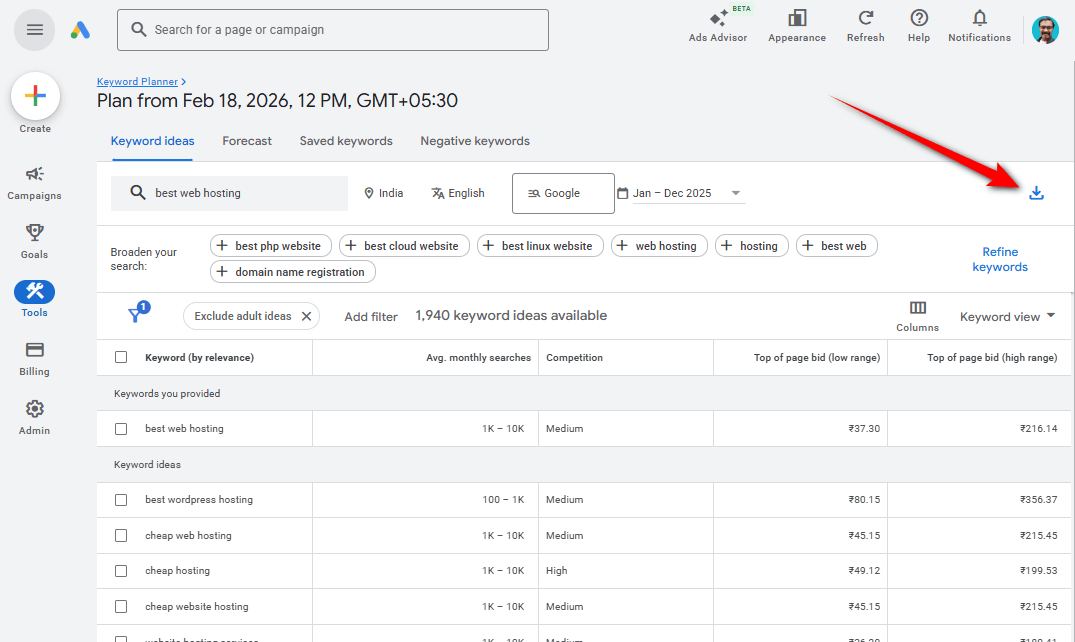
Save the file to your computer; it will include columns such as keyword, average monthly searches, competition, top‑of‑page bid (low and high), and more.
You can now open this CSV in Excel or Google Sheets and continue with your existing method (LEN formula, sorting by length, etc.) to surface the longest, most specific long‑tail keywords for your blog posts.
By following these steps, you will be able to find low competition long tail keywords that are much easier to rank for in Google search results.
Step 6: Organize the downloaded data
Save the keyword data on your computer or laptop and open it in Excel or Google Sheets.
The downloaded keyword sheet usually has several columns, such as Ad group, Keyword, Currency, Avg. monthly searches, Competition, Top of page bid (low), Top of page bid (high), and a few other metrics.
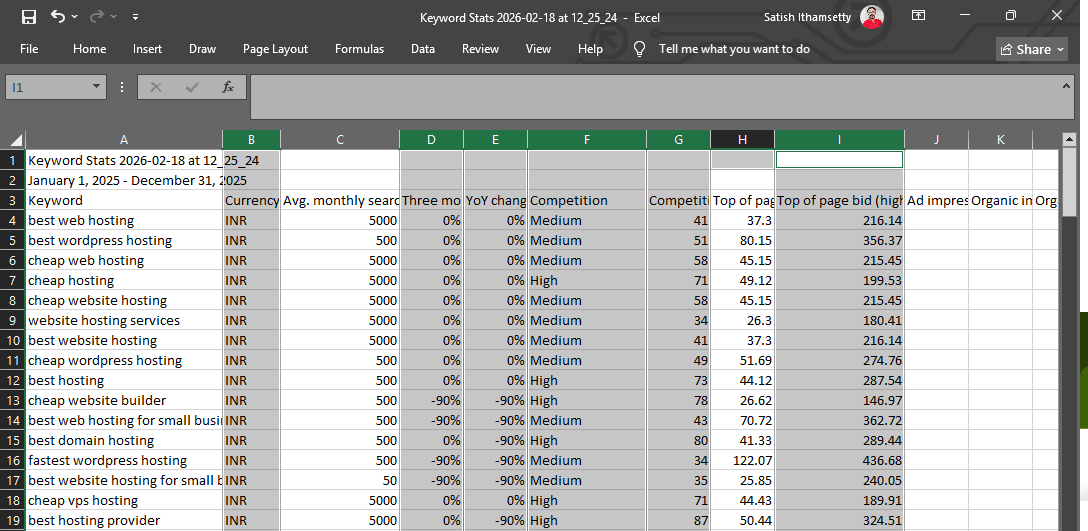
For this method, you only need the Keyword and Average monthly searches columns. Delete the rest of the columns, so you have a clean sheet with just these two columns before you start applying the formula.
Step 7: Apply the formula
After the Average monthly searches column, insert a new column C. In cell C2, type the formula =LEN(A2) and press Enter.
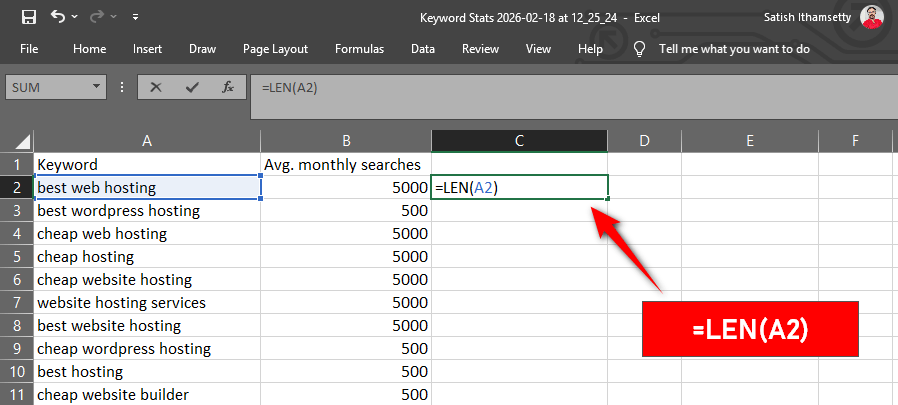
This formula calculates the total number of characters in each keyword, which helps you quickly identify the longer, more specific long‑tail phrases.
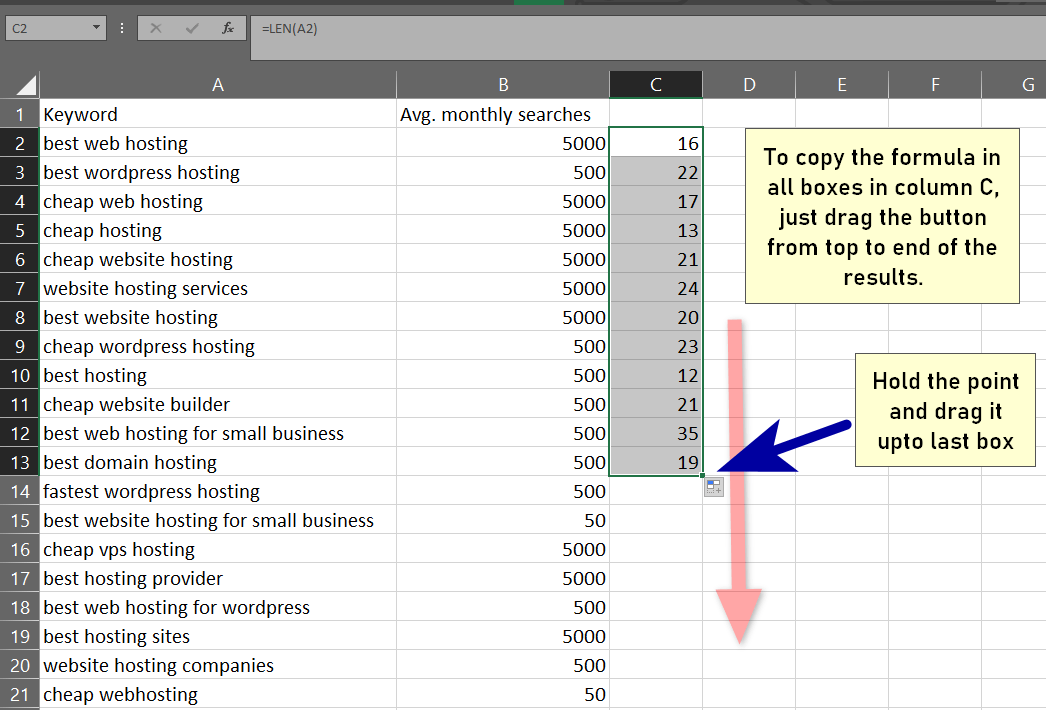
Now copy this formula down to all rows by dragging the small plus handle at the bottom‑right corner of cell C2 to the end of your keyword list.
Step 8: Sort the keywords from long to short
After filling column C with the LEN formula, you need to sort the data so that the longest keywords appear at the top.
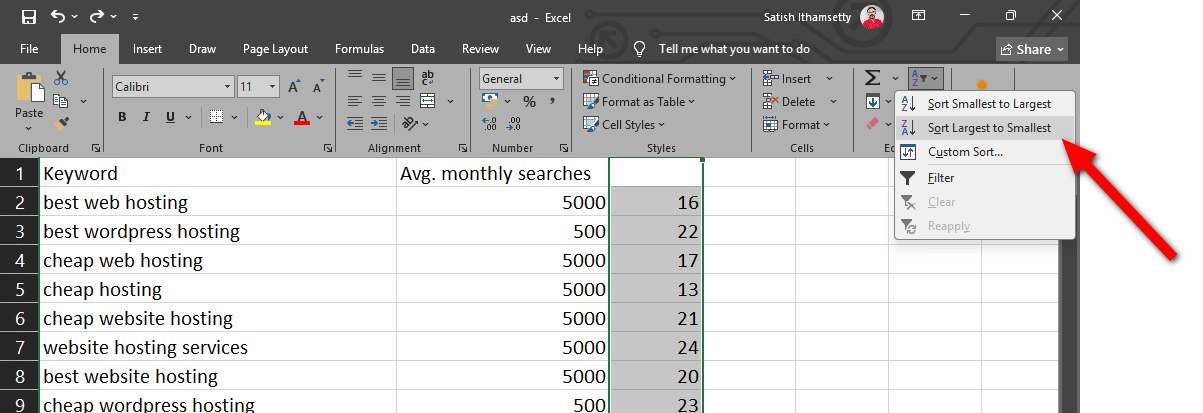
Select any cell in column C, then go to the Home tab and click on Sort & Filter. Choose Sort Largest to Smallest (or Z to A in Google Sheets).
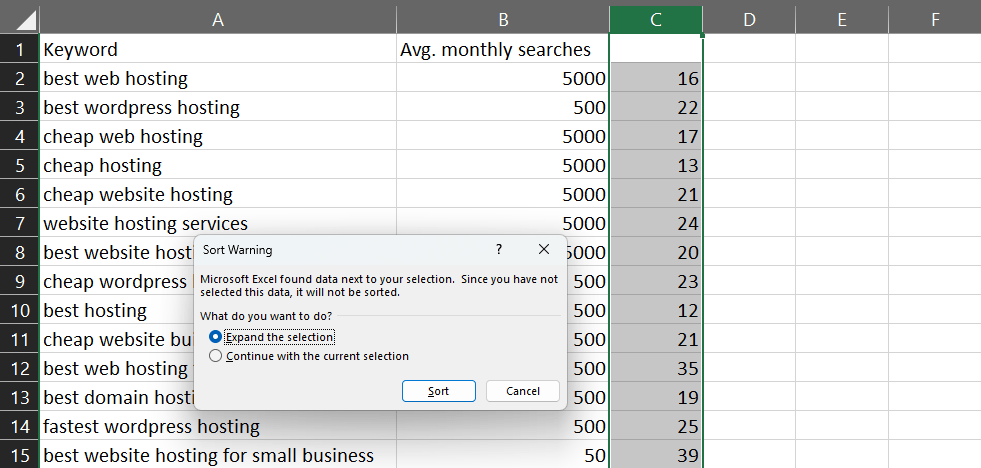
When prompted, select Expand the selection and click the Sort button so that the entire row (keyword + search volume + length) stays together.
Your keyword list will now be sorted automatically, and the longest long‑tail keywords will come first.
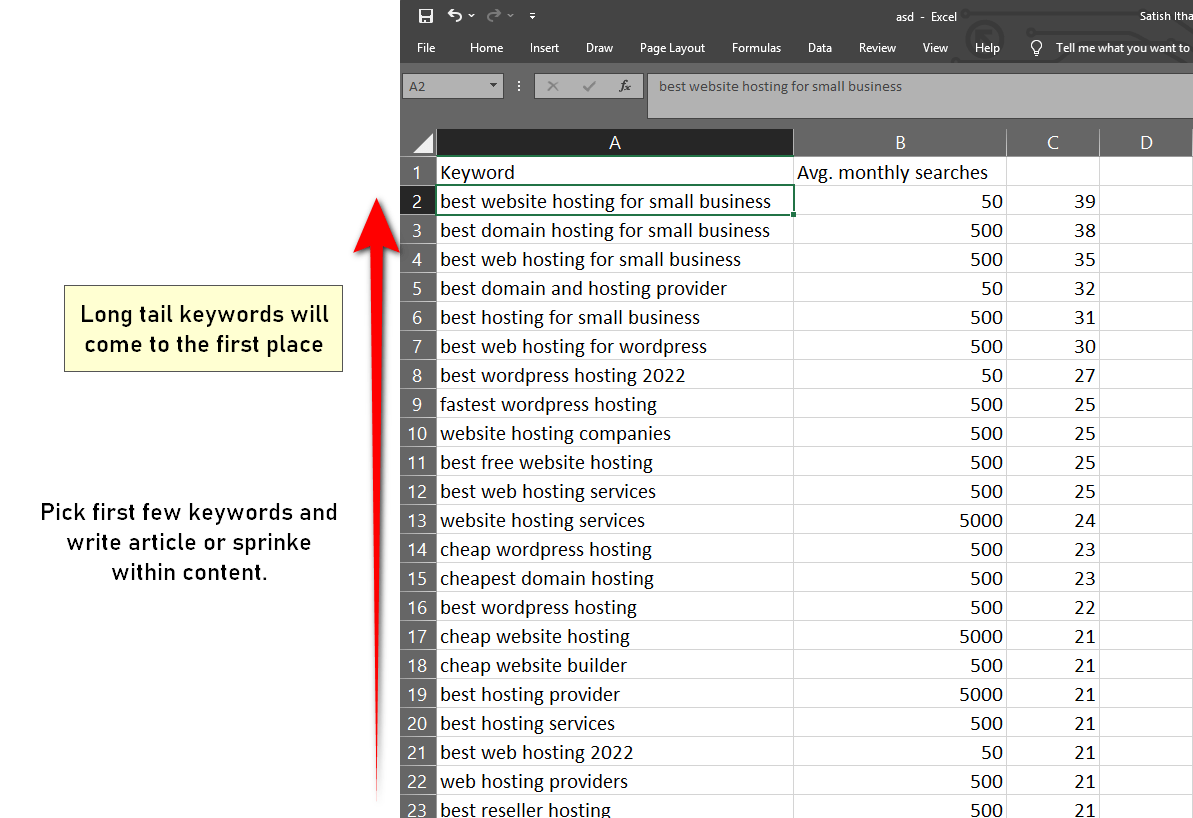
At this stage, you have a refined list of long‑tail keywords generated using a completely free method.
Pick the first 20–25 highly relevant long‑tail keywords and place them naturally within your article – in headings, subheadings, and body text – without disturbing the sentence structure or readability.
Finally, select the best long‑tail keywords from this list as the main topics for your new blog posts.
This is the exact process I use with the free Google Keyword Planner to discover powerful long‑tail keywords for my content.
Other ways to generate long‑tail keyword ideas (before using GKP)
Before you open Google Keyword Planner, it is smart to collect some long‑tail keyword ideas from a few quick, free sources.
These give you real search phrases and help you better understand user intent.
- Use Google Autocomplete by typing your main topic into the search bar and noting the longer suggestions that appear.
- Check the People Also Ask box on the results page to find question‑based long‑tail queries.
- Scroll to the bottom of the SERP and review the Related searches list for additional keyword variations.
- Try external tools like KeywordTool.io, KWFinder, or Semrush to generate more long‑tail ideas from seed keywords or competitor URLs.
- Finally, validate and expand all of these ideas in Google Keyword Planner to check search volumes, discover extra related terms, and build a strong long‑tail keyword list for your content.
Next steps for your keyword strategy
- Learn more advanced keyword research tips in my detailed keyword tools guide.
- Read my guide on how to promote blog posts to drive more traffic after you publish.
- Use this on‑page SEO checklist to optimize each article you write using your new long‑tail keywords.
Frequently Asked Questions (FAQs)
What is a long tail keyword?
A long tail keyword is a longer, more specific keyword phrase that usually contains three or more words. It targets a narrow audience and is easier to rank for compared to broad, one‑word keywords.
What is a long tail keyword example?
If your main keyword is “shoes”, a long tail keyword example would be “red Reebok running shoes for men”. It clearly describes what the user wants and is much more targeted.
How many words is a long tail keyword?
Most long tail keywords have between three and seven words, but some can be even longer, especially question‑based or conversational searches.
Do long tail keywords still work?
Yes, long tail keywords still work very well. They usually have lower search volume but less competition and higher conversion rates, so they are great for bloggers and niche sites.
How do you use long tail keywords in content?
Use long tail keywords naturally in your title, meta description, headings, first and last paragraphs, body content, and image alt text. Make sure the sentences read smoothly and stay relevant to the topic.
Is Google Keyword Planner still free for SEO in 2026?
Yes, Google Keyword Planner is still free to use in 2026. You only need a Google Ads account, and you can use the tool for SEO keyword research even if you are not running any ads.
How do I use Google Keyword Planner without running ads?
Create a free Google Ads account, skip or pause any campaign setup, then go to Tools & Settings → Keyword Planner. You can use all the keyword research features without spending money on ads.
What is a good search volume for long tail keywords?
For long tail keywords, even 50–500 searches per month can be very good if the keyword is highly relevant and has low competition. Focus more on intent and competition than just big numbers.
Final Words
Google Keyword Planner is still one of the best free tools for finding profitable long‑tail keywords, especially if you are a blogger, affiliate marketer, or small business owner.
Once you finish collecting and organizing your keyword data, the next step is to focus on low‑competition, high‑intent long‑tail keywords that can actually rank and drive targeted traffic.
Today, Google is smart enough to understand natural language, search intent, and even misspelled queries, and it automatically suggests relevant long‑tail keyword variations as users type.
That is why using specific, intent‑based phrases like “how to find long tail keywords with Google Keyword Planner” or “best long tail keywords for blog SEO” is far more effective than targeting only broad, generic keywords.
There are many premium tools available for finding low‑competition long‑tail keywords, but Google Keyword Planner gives you reliable keyword ideas and search volume data at no cost.
When you combine these long‑tail keyword insights with smart on‑page SEO, semantic keywords, and high‑quality content, your articles have a much better chance of ranking higher and attracting consistent organic traffic over time.
If you use long‑tail keywords strategically in your titles, headings, meta descriptions, FAQs, and body content, each article becomes a targeted asset instead of a random post, which leads to better CTR, higher engagement, and more conversions.
I hope this updated guide on how to find long‑tail keywords using Google Keyword Planner helps you build a strong keyword strategy and boost your blog’s organic traffic in 2026 and beyond.







Very good and simple article to understand for newbie. Thanks a lot.
Hello Satish,
Great tips over here 🙂
This is something I have always struggled with. Finding long tail keywords for my blogs. We all know that keywords are something very important for ranking our sites well among the SEO.
There are many guides which tell us about how to add best long tail keywords to get us going, but I have always struggled with this very matter through my blogging career.
This guide of yours is something very handy thing to get around for me for today. I have never imagined that Google Adwords can work so efficiently in getting us a long tail keyword.
The steps and the pictures you mentioned up here are clearing almost everything regarding this topic.
Thanks for the share.
Shantanu.
Hey, Sathish Bro
Smart plan to locate a long tail keyword selection. Will experiment and apply to my upcoming work as well.
Thanks
Hi Satish,
I have been using Google Keyword Planner, and it worked amazing well for me to look for Long tail keywords.
Thanks for the great share.
Have a good week ahead.
Hey, Satish!
Your post is fantastic and helpful for all the bloggers. Your rocked man. Keep up the excellent work.
Thank you 🙂